

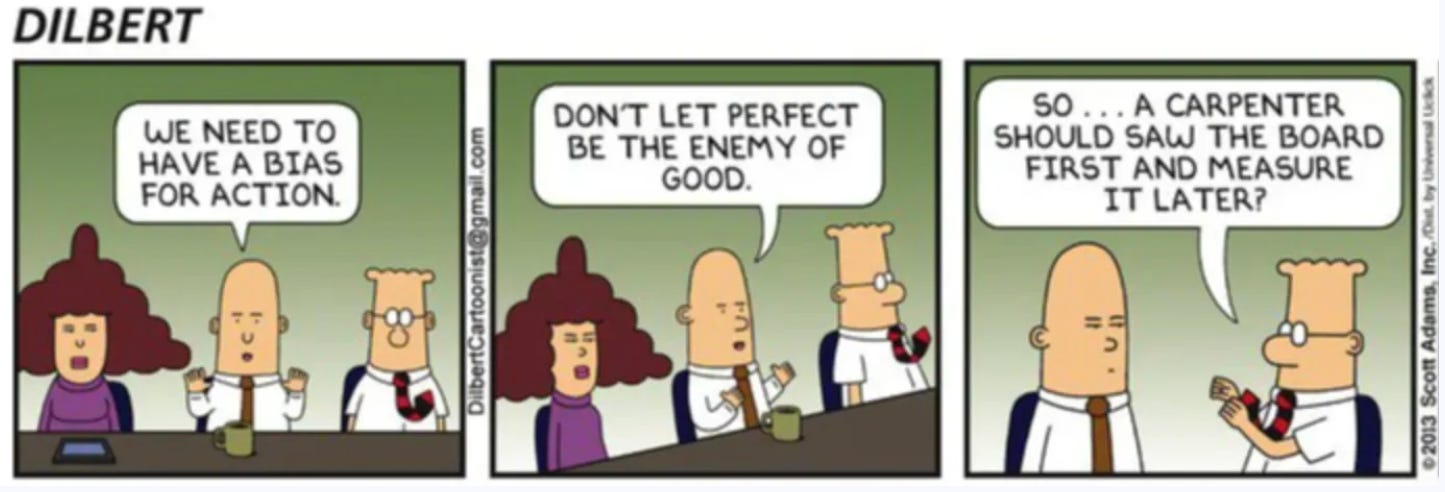
Like many people in the tech space, I am biased to action. It is a generally a great trait that helps to move forward and get things done. And it just feels good! Being a manager I also feel the extra need for speed since projects inevitably slow down when more and more people get involved.
It’s a trait that I was naturally imbued with and that I further developed through my career. It’s a resume builder and something that’s typically sought after in managers.
what is minimum timeboxing?
Yet, there are situations and problems where deliberately slowing down is necessary. It is necessary to ensure you can evaluate all the ideas. It is necessary so you can “sleep on it” and let it brew in your head. It is necessary so you can reflect on the problem itself (in the words of my manager “to live in the problem space”). It is necessary so others who are involved can reflect on it on their own timeline.
So how do you do this without compromising your core bias to action? How do you reconcile the two? For someone with a bias to action it is hard to be still and not act. I know it is for me.
Minimum timeboxing is a technique I came up with recently to address this. Timeboxing, a well established personal productivity and project management technique, helps to move things along. It helps to be more biased to action by limiting how much you spend on a decision.
Minimum timeboxing, takes the same approach but defines the minimum time you must spend on a decision. In fact, you can combine the two and specify both the minimum and the maximum time.
where and how do you use it?
There isn’t more to this technique — you can start using it right away. But I want to dive deeper into why and when it is important to sometimes not move fast, especially in times when you feel the extra push.
A great place to start is with the classic decision matrix below.
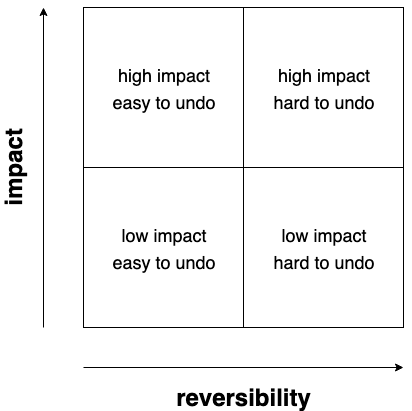
The decisions that are high impact and hard to undo should definitely have a minimum timebox. The ones in the upper left and lower right quadrants should be seriously considered as well, while the low impact / easy to undo are good candidates for moving fast.
Decision matrix aside sometimes there is urgency around problems but before you jump into action take some time to think where this urgency comes from. While some decisions are truly urgent, you should ask yourself is the urgency real? Is it self-generated due to your stress / bias to action / subconscious want to just-be-done-with-it?
If you are a problem solver like me and like to move fast, there is a good chance that you are feeling these urges. On the other hand, could they be coming from someone else in the organization who is dealing with similar emotions?
Using minimum timeboxing is a way to give yourself a chance to get immersed in the problem and to ensure that you don’t jump to a rushed decision.
P.S. I’m sure someone somewhere already thought of this idea but I personally haven’t heard of it.
If you’re an engineer, check out this article by Rich Hickey (creator of Clojure) that is on a very much related topic — Step Away from the Computer or Hammock-driven Development.